
English
Views: 0 Author: Site Editor Publish Time: 2026-02-08 Origin: Site


In today’s fitness market, more people are looking for training equipment that is effective, space-efficient, and adaptable to different workout levels. Whether for home gyms, commercial fitness centers, or training studios, the question often comes up: Is a dumbbell bench really effective for strength training?
From our experience working closely with gyms, distributors, and individual fitness users, the answer is clear—a well-designed dumbbell bench is one of the most effective and versatile pieces of strength equipment available. When paired with dumbbells, it supports a wide range of exercises that target major muscle groups, improves movement control, and scales easily from beginners to advanced athletes.
In this article, we explore how a dumbbell bench works, why it is effective, and why it continues to be a core product in modern strength training environments.
A dumbbell bench is a supportive training platform designed to be used with free weights. Unlike fixed machines, it allows the user to move naturally while maintaining proper body alignment. Most dumbbell benches are flat or adjustable, enabling exercises at different angles such as flat, incline, and decline positions.
From a functional standpoint, the bench provides:
Stable support for the torso
Improved exercise range of motion
Better posture and joint alignment
Increased training safety
This makes it suitable for both home fitness setups and commercial gyms.
Yes—very effective.
A dumbbell bench is one of the most reliable and adaptable tools for strength training because it combines free-weight resistance with controlled body positioning. This combination creates a training environment that promotes natural movement, muscle coordination, and long-term strength development.
Unlike fixed machines that guide the body along predetermined paths, a dumbbell bench allows the user to move freely while maintaining proper alignment. This freedom forces stabilizing muscles to engage, improves neuromuscular coordination, and better reflects real-world movement patterns. For both home and commercial fitness environments, this makes the dumbbell bench a highly effective foundation for strength training programs.
The effectiveness of a dumbbell bench comes from how it supports functional resistance training rather than isolated, machine-restricted movement.
Training Aspect | Effectiveness Benefit |
Free weight movement | Activates stabilizing muscles and improves control |
Adjustable angles | Targets muscles from multiple directions |
Natural motion paths | Reduces joint stress and supports safer lifting |
Progressive loading | Enables steady long-term strength gains |
Exercise variety | Prevents plateaus and maintains training motivation |
Because dumbbells move independently, the body must constantly correct balance and alignment. This results in higher muscle activation per repetition compared to many machine-based exercises. Over time, this leads to stronger joints, improved coordination, and more transferable strength.
One of the biggest advantages of a dumbbell bench is its exceptional muscle coverage. With only a bench and a pair of dumbbells, users can train nearly the entire upper body and core.
Muscle Group | Example Exercises |
Chest | Dumbbell bench press, incline press, flyes |
Shoulders | Seated shoulder press, lateral raises |
Back | One-arm rows, reverse flyes |
Arms | Bicep curls, triceps extensions |
Core | Weighted sit-ups, Russian twists |
This level of versatility makes a dumbbell bench a high-value investment for any fitness space. Instead of purchasing multiple machines for different muscle groups, one bench can support dozens of exercises, reducing equipment costs and space requirements.
While resistance machines play an important role in rehabilitation and beginner programs, many trainers and athletes prefer dumbbell bench workouts for functional strength development.
Feature | Dumbbell Bench | Fixed Machines |
Movement freedom | High | Limited |
Stabilizer activation | Strong | Minimal |
Space efficiency | Excellent | Requires more space |
Skill development | Improves coordination | Lower transfer |
Long-term progression | Flexible | Often limited |
Machines stabilize the load for the user, which can reduce the need for balance and coordination. In contrast, dumbbell bench exercises require the body to control each movement actively. This leads to better motor learning and improved strength transfer to daily activities and athletic performance.
For users focused on real strength, balance, and muscle control, the dumbbell bench offers clear long-term advantages.
Another reason the dumbbell bench remains widely used is its ability to scale across different fitness levels.
Beginners Benefit From:
Learning correct movement patterns
Starting with light weights and controlled range of motion
Building joint stability and muscle coordination safely
A bench provides physical support that helps beginners maintain proper posture, reducing the risk of injury while learning basic lifts.
Advanced Lifters Benefit From:
Progressive overload with heavier dumbbells
Unilateral training (one side at a time) to correct imbalances
Improved muscle symmetry and control
Because resistance is entirely user-controlled, training intensity can be adjusted precisely. This adaptability allows the same bench to remain useful as strength levels increase over time.
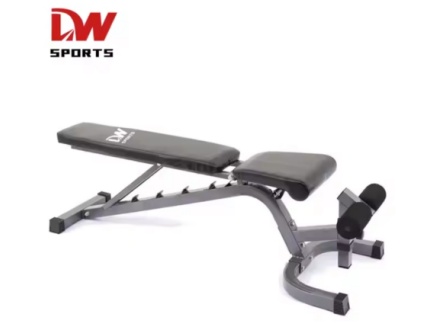
Adjustable dumbbell benches significantly expand training possibilities by allowing users to change bench angles. This adjustability transforms a single piece of equipment into a multi-purpose training platform, making workouts more efficient, targeted, and adaptable for different fitness goals.
Bench Angle | Primary Training Focus |
Flat | Overall chest and arms |
Incline | Upper chest and shoulders |
Decline | Lower chest emphasis |
Upright | Shoulder stability and core engagement |
Changing the bench angle alters muscle activation patterns, allowing users to target specific muscle fibers more effectively. For example, incline positions place greater emphasis on the upper chest and anterior shoulders, while decline angles shift load toward the lower chest. Upright positions increase core engagement and shoulder stabilization, supporting functional strength development.
This flexibility eliminates the need for multiple fixed benches or machines. As a result, adjustable dumbbell benches are especially valuable for:
Home gyms with limited space, where equipment must serve multiple purposes
Commercial gyms aiming to maximize floor efficiency, especially in high-traffic areas
Training programs requiring exercise variety, such as athletic conditioning or group training
By replacing several single-purpose benches, an adjustable dumbbell bench improves return on investment for both individual users and facility operators.
Training effectiveness depends not only on exercise selection but also on bench construction quality. A poorly designed bench can compromise lifting mechanics, reduce confidence, and increase injury risk—especially during heavy or unilateral dumbbell exercises.
Important Design Factors Include:
High-density padding for comfort and spinal support during pressing and seated movements
Non-slip foot design to maintain stability on different flooring surfaces
Strong steel frame to support high load capacity and long-term durability
Secure angle adjustment system to prevent shifting or collapse during use
A well-engineered dumbbell bench allows athletes to focus entirely on performance rather than worrying about balance or structural integrity. This is particularly important in commercial gyms, where benches are subjected to repeated daily use by users of varying strength levels.
From a manufacturing and facility-management perspective, durable construction reduces maintenance issues, minimizes liability risk, and extends product lifespan.
From a training perspective, a dumbbell bench supports:
Progressive strength development through scalable resistance
Functional movement patterns that transfer to real-world activity
Injury-resistant joint mechanics through controlled, natural motion
Long-term exercise variety that helps prevent training plateaus
From an equipment perspective, it offers:
High usage frequency across multiple user types
Low maintenance requirements compared to complex machines
Excellent space efficiency in both home and commercial layouts
Broad user compatibility, from beginners to advanced lifters
These combined benefits explain why the dumbbell bench remains a core piece of strength equipment across home gyms, professional training facilities, and commercial fitness centers worldwide.
From a market standpoint, dumbbell benches continue to see strong demand because they align with modern fitness trends. Users increasingly favor minimalist, versatile equipment that delivers results without occupying excessive space or requiring complex operation.
Dumbbell benches remain popular because they:
Fit seamlessly into both home and commercial environments
Support minimalist and functional training approaches
Reduce reliance on bulky, single-purpose machines
Offer excellent cost-to-function value over time
For fitness brands, distributors, and gyms, dumbbell benches represent a core product category with broad appeal, stable demand, and long-term relevance in the evolving fitness market.
From our standpoint, a dumbbell bench is not just an accessory—it is a foundation tool. It enables functional strength, adapts to user growth, and complements almost any training program.
Whether the goal is muscle building, general fitness, or long-term training consistency, a dumbbell bench delivers reliable results when designed and used correctly.
If you’re exploring professional-grade dumbbell benches for home or commercial use, you can learn more at www.zy-fitness.com.
Q1: Is a dumbbell bench effective for full-body workouts?
Yes. While it mainly supports upper-body exercises, it can also be used for core and lower-body support movements.
Q2: Can beginners safely use a dumbbell bench?
Absolutely. With proper weight selection and form, beginners benefit greatly from controlled dumbbell bench exercises.
Q3: Is a dumbbell bench better than a barbell bench?
Each has advantages, but dumbbell benches allow greater range of motion and better muscle balance.
Q4: Does bench quality affect training effectiveness?
Yes. Stability, padding, and frame strength directly influence safety and workout performance.


